Scientific Publications

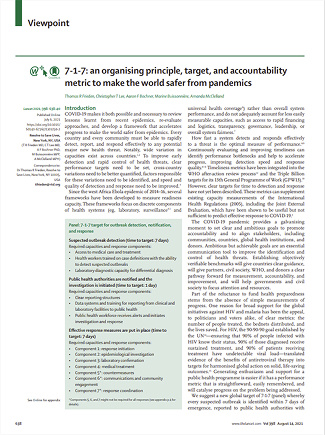
7-1-7: an organising principle, target, and accountability metric to make the world safer from pandemics

Clear, universal performance standards for outbreak detection, reporting and control can improve accountability, save lives, and accelerate global readiness for future pandemics. For The Lancet’s Viewpoint, experts from Resolve to Save Lives propose 7-1-7 as a global target for timely response to infectious disease outbreaks: detecting a suspected outbreak within 7 days, reporting and initiating a response within 1 day, and mounting an effective early response within 7 days.

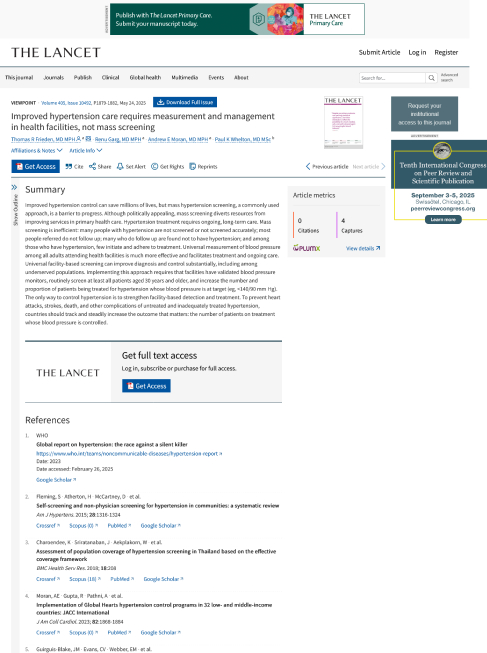
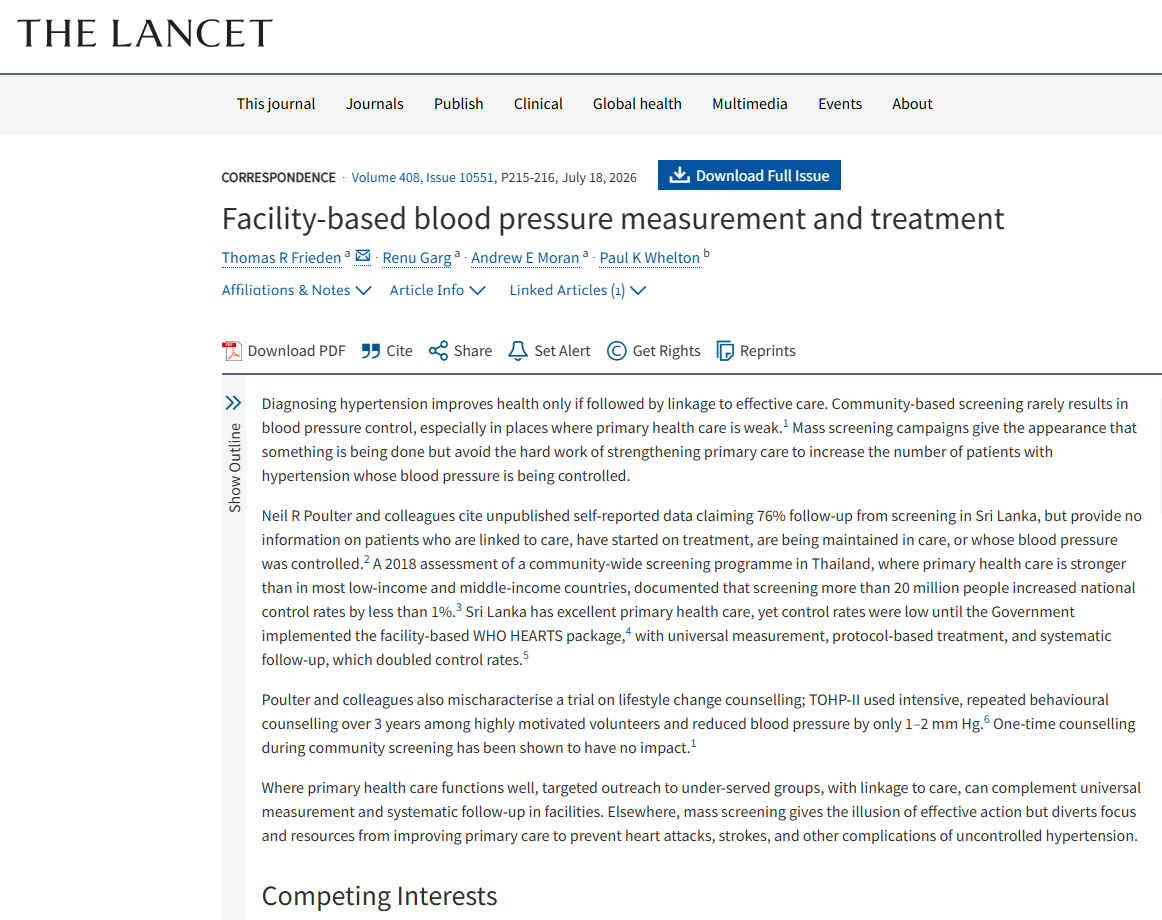
Improved hypertension care requires measurement and management in health facilities, not mass screening.

Mass hypertension screening diverts resources from primary care. Universal facility-based blood pressure measurement is more effective for improving hypertension diagnosis, treatment initiation, and long-term control.

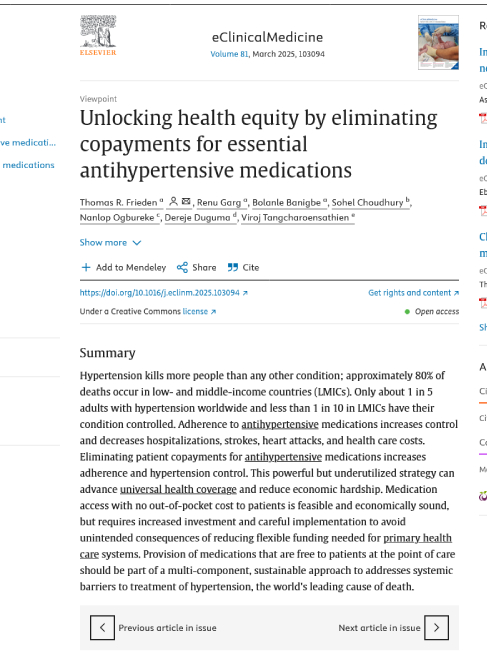
Unlocking health equity by eliminating copayments for essential antihypertensive medications

Eliminating copayments for antihypertensive medications increases adherence and blood pressure control while reducing cardiovascular events, advancing universal health coverage in low- and middle-income countries.

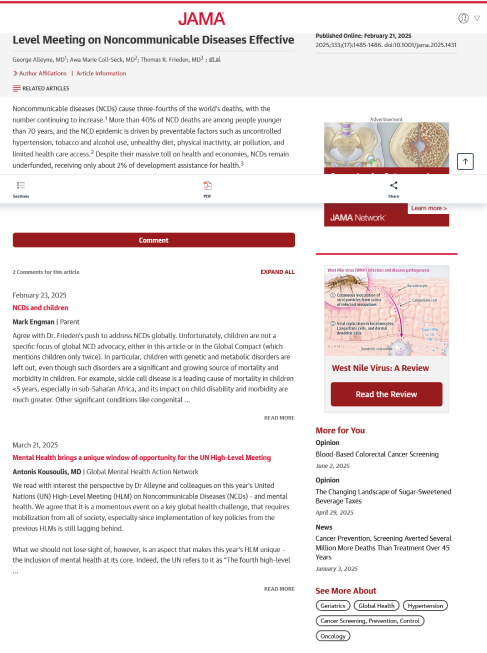
Fourth Time a Charm?—How to Make the UN High-Level Meeting on Noncommunicable Diseases Effective

Noncommunicable diseases cause three-fourths of global deaths but receive only 2% of development health assistance, despite being driven by preventable factors like hypertension and tobacco use.

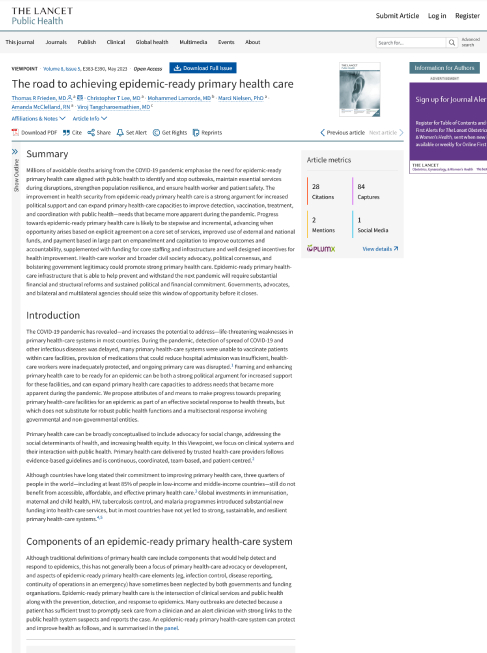
The road to achieving epidemic-ready primary health care

Epidemic-ready primary health care can identify outbreaks, maintain essential services during disruptions, and strengthen resilience. Progress requires financial reforms, political commitment, and integration with public health.

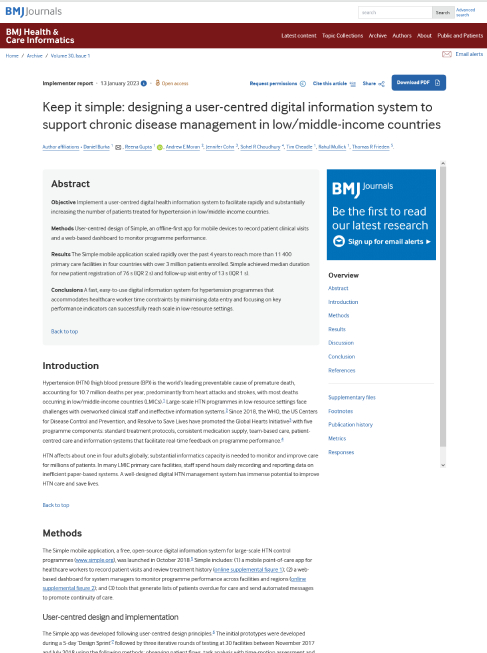
Keep it simple: designing a user-centred digital information system to support chronic disease management in low/middle-income countries

Simple, a user-centred digital app, scaled to over 11,400 facilities in four countries, managing 3 million hypertension patients with rapid data entry and improved blood pressure control.

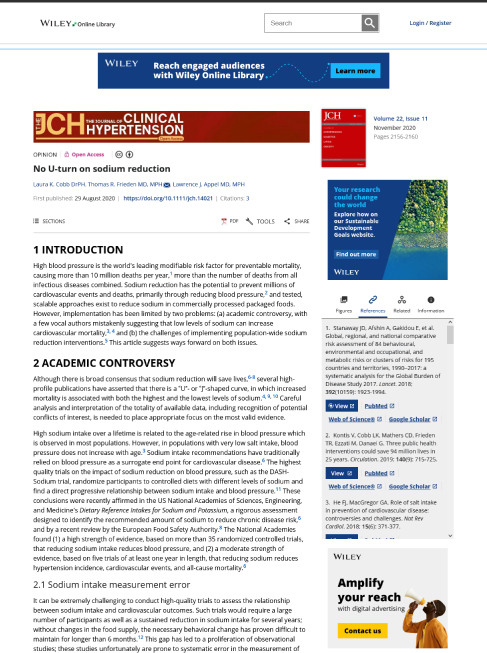
No U-turn on sodium reduction

Sodium reduction prevents cardiovascular deaths. Implementation requires tailored interventions for packaged foods, home-cooked meals, and restaurant foods in different countries.

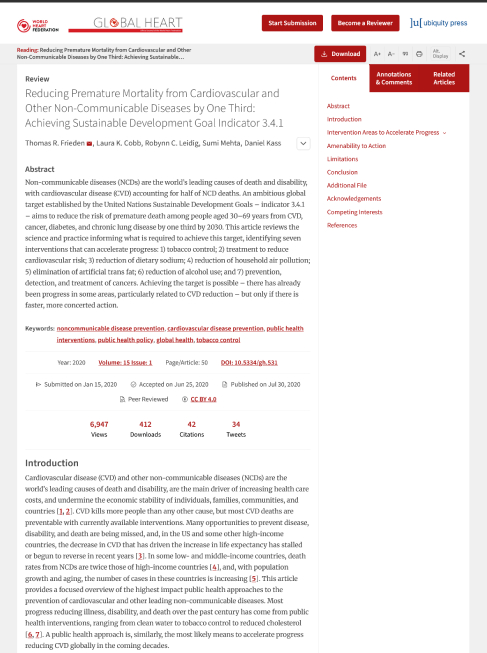
Reducing Premature Mortality from Cardiovascular and Other Non-Communicable Diseases by One Third: Achieving Sustainable Development Goal Indicator 3.4.1

The UN aims to reduce premature NCD deaths by one third by 2030. Seven key interventions can accelerate progress, including tobacco control, cardiovascular treatment, and sodium reduction.

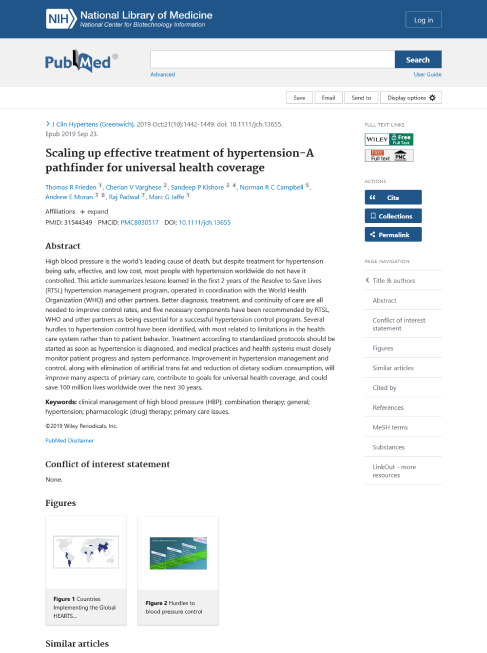
Scaling up effective treatment of hypertension-A pathfinder for universal health coverage

Five essential components and standardized protocols can improve hypertension control. Better management could save 100 million lives over 30 years through enhanced primary care systems.

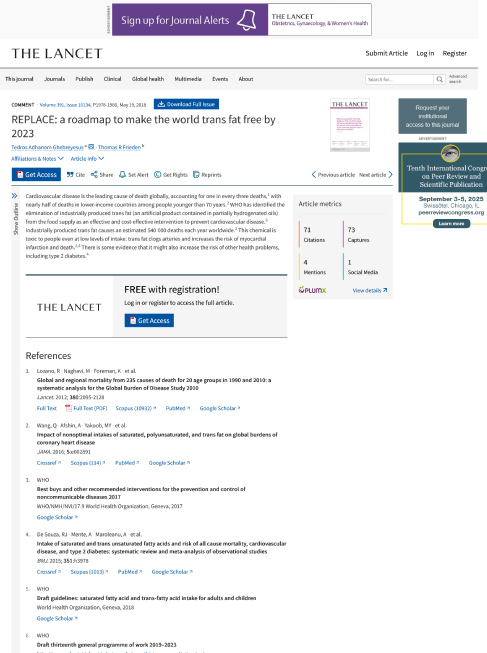
REPLACE: a roadmap to make the world trans fat free by 2023

Trans fat causes 540,000 deaths yearly and increases cardiovascular disease risk. WHO's REPLACE roadmap provides a cost-effective intervention to eliminate industrially produced trans fat globally.
Rapid DOTS

Rapid DOTS expansion in India.

Since late 1998 the coverage of the DOTS strategy in India has been expanded rapidly....
Placeholder-image

7-1-7: an organising principle, target, and accountability metric to make the world safer from pandemics

Clear, universal performance standards for outbreak detection, reporting and control can improve accountability, save lives,...
Improved hypertension

Improved hypertension care requires measurement and management in health facilities, not mass screening.

Mass hypertension screening diverts resources from primary care. Universal facility-based blood pressure measurement is more...
Unlocking health-Photo

Unlocking health equity by eliminating copayments for essential antihypertensive medications

Eliminating copayments for antihypertensive medications increases adherence and blood pressure control while reducing cardiovascular events,...
Fourth Time a Charm

Fourth Time a Charm?—How to Make the UN High-Level Meeting on Noncommunicable Diseases Effective

Noncommunicable diseases cause three-fourths of global deaths but receive only 2% of development health assistance,...
The road to achieving

The road to achieving epidemic-ready primary health care

Epidemic-ready primary health care can identify outbreaks, maintain essential services during disruptions, and strengthen resilience....
Keep it simple-Photo

Keep it simple: designing a user-centred digital information system to support chronic disease management in low/middle-income countries

Simple, a user-centred digital app, scaled to over 11,400 facilities in four countries, managing 3...
No U-turn-Photo

No U-turn on sodium reduction

Sodium reduction prevents cardiovascular deaths. Implementation requires tailored interventions for packaged foods, home-cooked meals, and...
Reducing Premature-Photo

Reducing Premature Mortality from Cardiovascular and Other Non-Communicable Diseases by One Third: Achieving Sustainable Development Goal Indicator 3.4.1

The UN aims to reduce premature NCD deaths by one third by 2030. Seven key...
Scaling up effective

Scaling up effective treatment of hypertension-A pathfinder for universal health coverage

Five essential components and standardized protocols can improve hypertension control. Better management could save 100...
REPLACE a roadmap

REPLACE: a roadmap to make the world trans fat free by 2023

Trans fat causes 540,000 deaths yearly and increases cardiovascular disease risk. WHO's REPLACE roadmap provides...
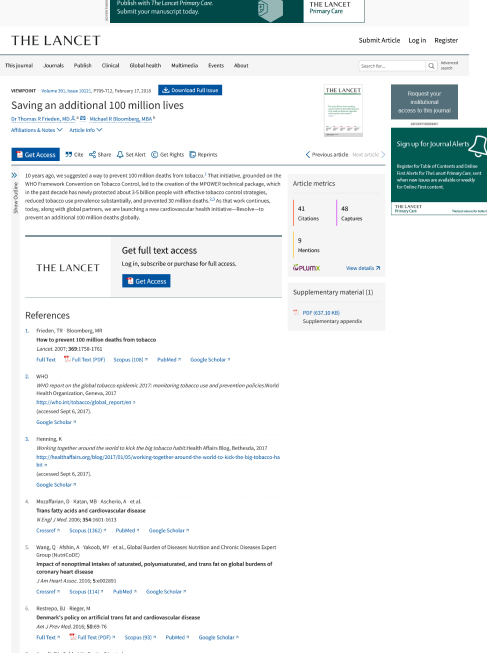
Saving an additional-Photo

Saving an additional 100 million lives

10 years ago, we suggested a way to prevent 100 million deaths from tobacco. That...
August 25, 2025

Rapid DOTS expansion in India.

Since late 1998 the coverage of the DOTS strategy in India has been expanded rapidly. In both 2000 and 2001 the country probably accounted for more than half the global
August 22, 2025

7-1-7: an organising principle, target, and accountability metric to make the world safer from pandemics

Clear, universal performance standards for outbreak detection, reporting and control can improve accountability, save lives, and accelerate global readiness for future pandemics. For The Lancet’s Viewpoint, experts from Resolve to
May 24, 2025
Frieden TR, Garg R, Moran AE, Whelton PK

Improved hypertension care requires measurement and management in health facilities, not mass screening.

Mass hypertension screening diverts resources from primary care. Universal facility-based blood pressure measurement is more effective for improving hypertension diagnosis, treatment initiation, and long-term control.
March 4, 2025
Frieden TR, Garg R, Banigbe B, Choudhury S, Ogbureke N, Duguma D, Tangcharoensathien V

Unlocking health equity by eliminating copayments for essential antihypertensive medications

Eliminating copayments for antihypertensive medications increases adherence and blood pressure control while reducing cardiovascular events, advancing universal health coverage in low- and middle-income countries.
February 21, 2025
George Alleyne, Awa Marie Coll-Seck, Thomas R. Frieden.

Fourth Time a Charm?—How to Make the UN High-Level Meeting on Noncommunicable Diseases Effective

Noncommunicable diseases cause three-fourths of global deaths but receive only 2% of development health assistance, despite being driven by preventable factors like hypertension and tobacco use.
May 4, 2023
Frieden TR, Lee CT, Lamorde M, Nielsen M, McClelland A, Tangcharoensathien, V

The road to achieving epidemic-ready primary health care

Epidemic-ready primary health care can identify outbreaks, maintain essential services during disruptions, and strengthen resilience. Progress requires financial reforms, political commitment, and integration with public health.
January 13, 2023
Burka D, Gupta R, Moran AE, Cohn J, Choudhury S, Cheadle T, Mullick R, Frieden TR

Keep it simple: designing a user-centred digital information system to support chronic disease management in low/middle-income countries

Simple, a user-centred digital app, scaled to over 11,400 facilities in four countries, managing 3 million hypertension patients with rapid data entry and improved blood pressure control.
August 29, 2020
Cobb LK, Frieden TR, Appel LJ.

No U-turn on sodium reduction

Sodium reduction prevents cardiovascular deaths. Implementation requires tailored interventions for packaged foods, home-cooked meals, and restaurant foods in different countries.
July 30, 2020
Frieden TR, Cobb LK, Leidig RC, Mehta S, Kass D.

Reducing Premature Mortality from Cardiovascular and Other Non-Communicable Diseases by One Third: Achieving Sustainable Development Goal Indicator 3.4.1

The UN aims to reduce premature NCD deaths by one third by 2030. Seven key interventions can accelerate progress, including tobacco control, cardiovascular treatment, and sodium reduction.
October 21, 2019
Frieden TR, Varghese CV, Kishore SP, Campbell NRC, Moran AE, Padwal R, Jaffe MG.

Scaling up effective treatment of hypertension-A pathfinder for universal health coverage

Five essential components and standardized protocols can improve hypertension control. Better management could save 100 million lives over 30 years through enhanced primary care systems.
May 19, 2018
Ghebreyesus TA, Frieden TR.

REPLACE: a roadmap to make the world trans fat free by 2023

Trans fat causes 540,000 deaths yearly and increases cardiovascular disease risk. WHO's REPLACE roadmap provides a cost-effective intervention to eliminate industrially produced trans fat globally.
February 17, 2018

Saving an additional 100 million lives

10 years ago, we suggested a way to prevent 100 million deaths from tobacco. That initiative, grounded on the WHO Framework Convention on Tobacco Control, led to the creation of